
Our Method of Beekeeping
Spring
Existing Hive Winter Configuration
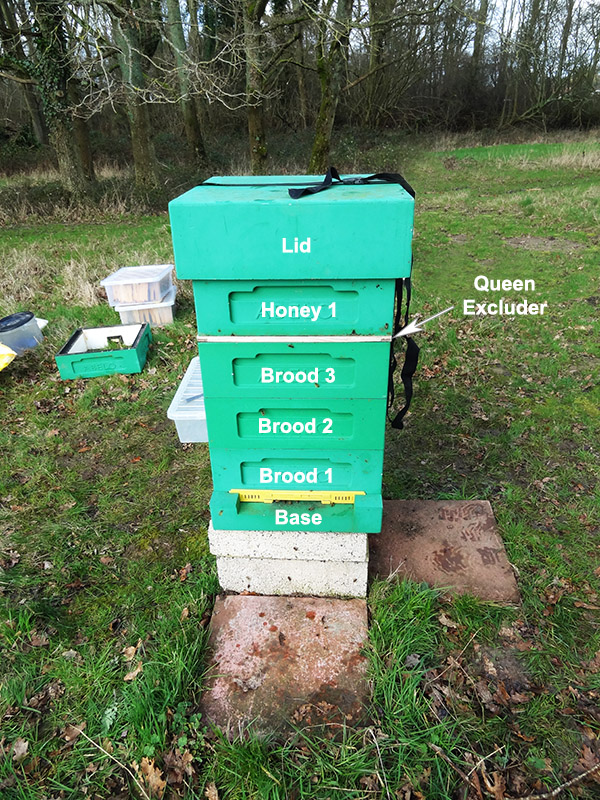
Global warming is having a noticeable affect and spring type weather is now typically one month ahead of where it should be. Today (18th February) the temperature is 16°C, daffodils, crocus, snowdrops are in full bloom as well as blackthorn trees which are covered in white flowers. The bees are active and are bringing in pollen, a sure sign that the queen is laying. Now is the time to change the configuration of our hives in preparation for the colony expanding and bees bringing in nectar. We will still need to feed the bees as there will not be much forage around plus the weather could turn cold. However having changed the configuration we are prepared for when forage becomes available and then we can manipulate the hive to accommodate the nectar flow rather than risking the bees swarming.
Image: 1

Dismantle The Hive
Image: 2

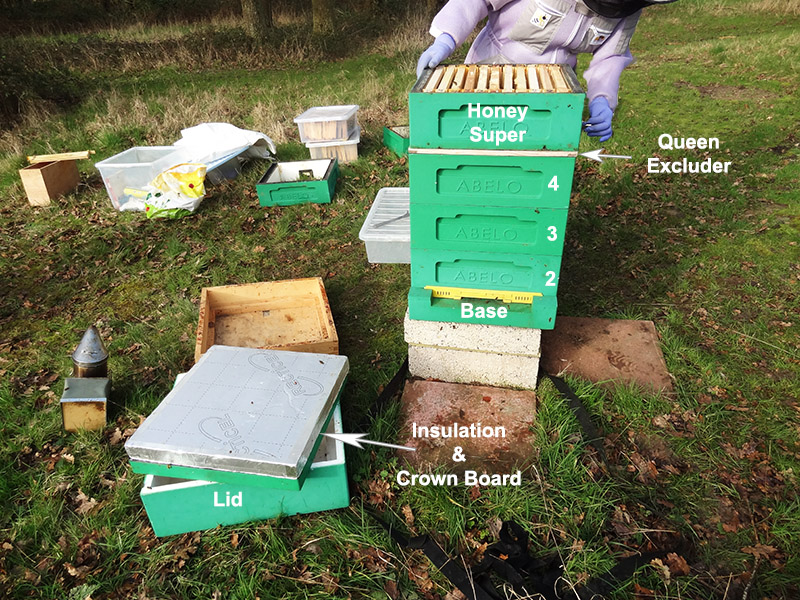
We start by splitting the hive above Box 1 and lift all of the top part of the hive onto an upturned lid. One of the advantages of poly hives are they are light plus at this point in time there will be little to no honey in the hive. Box 1 may contain a few bees but they will soon find their way into the bottom of Box 2. We discard all of the frames in Box 1 as they are typically three years old. The majority of the comb will be empty and very dark, unused by the bees at this time of year. The wax could contain pathogens that may cause illness, so this is part of our hygiene regime for all of the hives.
Image: 3

We will take this opportunity to give the base of the hive and the plinth a yearly clean with a stiff brush.
Empty and Refill Box with Frames
Image: 4

The old frames are removed from the box and placed in a sealable plastic box. The wax and the frames will be processed later. The wax will be saved and used for candles and the frames will be used as kindling for our log burning stove, nothing is wasted.
Image: 5

Frames with drawn comb that we saved from last year are loaded into the now empty box after we have given the box a bit of a clean. The bees will enjoy these frames as they will contain small amounts of honey.
Reassemble Hive Stack
Image: 6

The original top three boxes (2 – 4) are placed back on the base. As we have not separated these boxes the bees have been protected.
Image: 7

We have now removed the lid, insulation and crown board. The crown board and insulation are not separated because there will be a number of bees feeding on the fondant used in the winter feed. As you can see the colony are now exposed so we need to move swiftly to protect the cluster against heat loss. The queen excluder is placed to the top box.
Image: 8
The previous (cleaned) bottom box is now placed on the top of the queen excluder with all of the new frames shown in image 5. This will provide some extra food for the bees along with the fondant
Image: 9

The insulation and crown board are now placed on the top box. Once this is done the cluster of bees are secured from the outside.
Hive Early Spring Configuration
Finally for this first manipulation the lid is replaced. Most importantly the hive is strapped down to the plinth otherwise it can easily be blown over by wind gusts.
This configuration can be found in our Yearly Cycle pdf.
The next step will be in March/April when temperatures are consistently 15°C or more. We will then check box Honey 1; by this time of year the bees are likely to be adding nectar to the frames in this box. If these frames are reasonably full, but not necessarily capped, we will add another box, Honey 2. The frames in these two boxes will be “checker boarded” across both boxes such that between each frame of nectar will be an empty frame. Initially these empty frames will have foundation wax.
Image: 10
Hive Late Spring Preparation
In April/May when temperatures are consistently 15°C or more we will then add a second super box above the Queen Excluder – Honey 2. We can then checker board the frames between the two super boxes. The reason for doing this is to prevent a honey barrier being created above the brood area. If this happens the bees are more likely to swarm.
Image: 11

If adding the new box is combined with a full colony inspection then we remove Honey 1 box from the hive stack and place it next to Honey 2 box to make the checker boarding process easier.
Image: 12

Checker Boarding The Honey Super
Image: 13

With the two boxes next to each other we can start the process of moving frames. The intention is that Honey 2 will be filled with half of Honey 1 frames and vice versa. The frames from Honey 1, which have been on the hive since early Spring, will be partially filled with new honey.
Image: 14

The frames being moved from Honey 2 will either be frames with foundation wax (as in this image) or better still, will be drawn comb if available.
Image: 15

We continue the process for both boxes and all 22 frames.
Image: 16

Checker boarding process complete. Now the bees have plenty of room to add honey to either Honey 1 or Honey 2 boxes
Hive Late Spring Configuration
The hive stack is reassembled which now includes Honey 2. We will not change this configuration until late Summer early Autumn, when we start preparations for winter and colony survival. The super frames from Honey 1 and 2 will be inspected each week and as they fill up and are capped we remove and process them. The vacant slot in the box is either filled with “wet frames” (i.e. frames that have had honey extracted) or frames with foundation wax.
Image: 17
